One Transaction. Every Department. One Source of Truth: The Technology Behind Bay 53 ERP
What if one transaction could connect sales, inventory, billing, accounting, workflows, and analytics? See how Bay 53’s integrated architecture drives faster, more controlled operations.
Your Business Doesn’t Have a Data Problem. It Has a Data-Flow Problem.
A customer places an order.
It sounds simple.
But that single transaction can trigger multiple activities across your business.
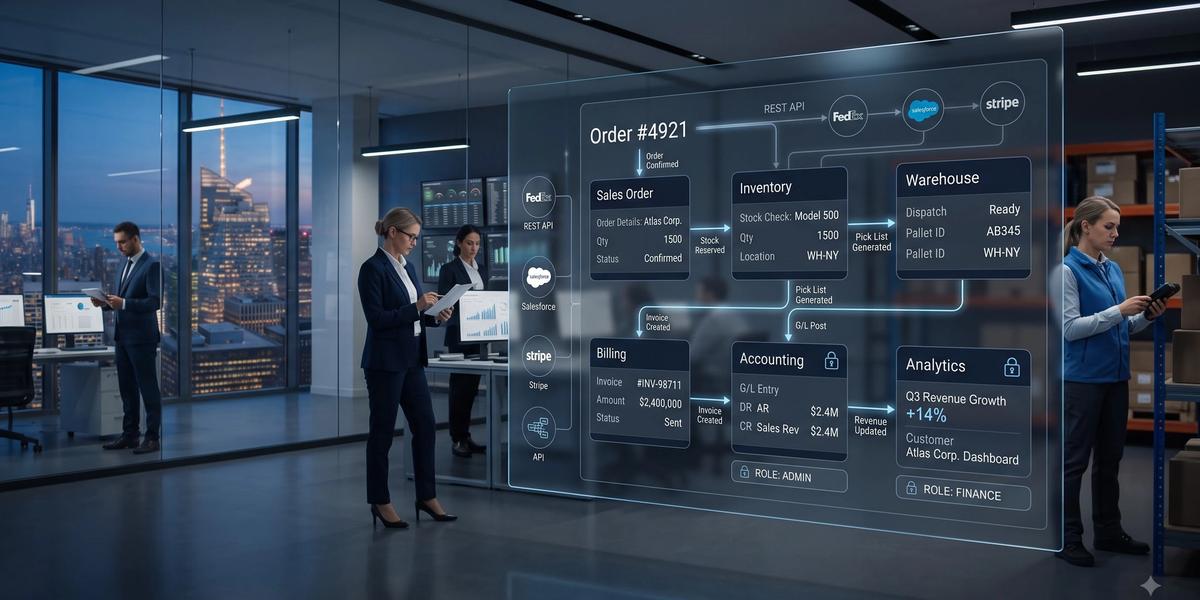
Sales records the order. Inventory checks availability. Billing generates the invoice. Accounting records the financial impact. Management eventually needs that information for reports and analysis.
When these functions operate through disconnected systems, spreadsheets, or manual processes, the same information gets entered multiple times.
And that creates a familiar question:
Which number is correct?
The real problem isn't a lack of data.
It's a lack of connected data flow.
The Real Value of ERP Is What Happens Between Modules
ERP software is often evaluated by its list of features:
- Accounting
- Inventory
- Billing
- Purchasing
- Production
- CRM
- Reporting
- Analytics
But having all these functions in one system is only part of the value.
The real advantage comes from how these modules work together.
Bay 53 is designed as an integrated ERP platform that connects key business functions, helping organizations maintain consistent information and reduce duplicate data entry.
The objective is simple:
Enter information once. Let connected processes use it wherever it is needed.
From One Transaction to a Connected Workflow
Consider a typical sales transaction.
1. The Business Event Begins
A customer order enters the system.
Instead of becoming an isolated sales record, it becomes part of a connected business process.
2. Inventory Responds
The transaction can connect with inventory processes, giving teams better visibility into stock availability and movement.
Bay 53 supports inventory management features such as real-time stock visibility, multi-warehouse management, barcode and batch tracking, stock transfers, reorder alerts, and inventory analytics.
3. Billing Follows
Billing doesn't need to become another manual data-entry exercise.
Bay 53 supports invoice generation, recurring billing, payment tracking, tax and discount management, receivables, aging reports, and billing analytics.
4. Accounting Stays Connected
The financial impact of the transaction can flow into the accounting environment.
Instead of repeatedly recreating information, finance teams can work with connected business data.
5. Management Gets the Bigger Picture
Once operational information is connected, dashboards and reports become more meaningful.
Management can gain visibility into business activity and performance without relying entirely on manually consolidated reports.
This creates a simple flow:
Business Activity → Connected Processes → Consistent Data → Real-Time Insights
Data Reuse Instead of Data Re-entry
This is one of the biggest differences between disconnected software and an integrated ERP.
Disconnected Workflow
Sales → Spreadsheet → Inventory System → Accounting Software → Reporting
Every handoff creates opportunities for:
- Duplicate data
- Delayed updates
- Manual errors
- Inconsistent records
- Reconciliation work
Integrated Workflow
Business Transaction → Connected Modules → Shared Business Data → Analytics
Instead of repeatedly copying information between systems, connected modules can work with the same business information.
That means employees can spend less time moving data and more time managing the business.
Integration Creates Better Operational Control
Connected data doesn't just improve efficiency.
It improves visibility and control.
Sales can access customer and transaction information.
Operations can work with inventory and purchasing data.
Finance can work with billing and accounting information.
Management can use dashboards and analytics to understand overall performance.
Bay 53 brings these functions together within an integrated ERP environment, helping businesses create a more unified view of their operations.
Every Business Has Its Own Workflow
No two businesses operate exactly the same way.
A distributor may require purchase approvals.
A manufacturer may need production and quality-control stages.
A service business may have specific approval and billing processes.
A growing organization may need different workflows across locations or departments.
That's why flexibility matters.
Bay 53 supports configurable processes and custom workflows, allowing businesses to adapt the platform around their operational requirements.
The goal isn't to force the business to change the way it works.
The goal is to configure technology around the way the business operates.
Connected Doesn't Mean Uncontrolled
An ERP contains critical business information.
Not every employee should have access to everything.
Bay 53 supports role-based access controls and security features designed to help businesses manage access to important information and processes.
This creates an important distinction:
Connected data does not mean unrestricted data.
Businesses can connect their operations while maintaining control over who can access specific information and functions.
Automation Turns Data Into Action
Connected data becomes even more valuable when routine processes can be automated.
Bay 53 supports automation across areas such as business workflows, inventory processes, billing, financial operations, and reporting.
The objective is to reduce repetitive manual work and keep business processes moving efficiently.
That can mean:
- Less manual entry
- Fewer handoffs
- Faster processing
- Better visibility
- More consistent operations
Your ERP Shouldn't Become Another Data Island
Modern businesses rarely rely on just one application.
They may use websites, payment platforms, e-commerce systems, logistics tools, or specialized applications.
Your ERP should be able to work as part of that broader technology ecosystem.
Bay 53 provides API capabilities that allow businesses to connect the ERP with external applications and services when required.
This means the ERP can become a connected part of the technology environment rather than another isolated system.
Real-Time Visibility Improves Decision-Making
One of the biggest benefits of connected data is visibility.
Without integration, management may have to wait for different departments to prepare, exchange, and reconcile reports.
With connected business information, decision-makers can get a clearer and more current view of areas such as:
- Sales
- Revenue
- Inventory
- Operations
- Financial performance
- Customer activity
- Business trends
Bay 53 provides dashboards, reporting, and analytics capabilities that help turn operational data into actionable business insights.
The question changes from:
"What happened?"
to:
"What's happening now, and what should we do next?"
Built for Growing Businesses
Growth brings complexity.
More customers mean more transactions.
More products mean more inventory.
More locations mean more coordination.
More employees mean more processes.
Disconnected tools can become increasingly difficult to manage as the business grows.
Bay 53 brings multiple business functions into one ERP environment, giving organizations a connected foundation that can support their evolving operational needs.
The objective isn't simply to add more software.
It's to create a stronger way of running the business.
The Business Impact of Connected Architecture
ERP architecture may sound like an IT concern.
It isn't.
It directly affects business performance.
When systems are disconnected:
Data moves slowly → reconciliation increases → decisions slow down.
When systems are connected:
Data flows between functions → visibility improves → teams respond faster.
That's the real business value of ERP integration.
Bay 53 Is More Than a Collection of Modules
Accounting software can manage accounting.
Inventory software can manage inventory.
CRM software can manage customer relationships.
Billing software can manage invoices.
But the greater value comes when these functions stop operating as separate systems.
That's the idea behind Bay 53:
Connect the business once. Use the information everywhere it matters.
When business data can move across departments instead of being repeatedly recreated, teams gain greater coordination, visibility, and control.
That creates more than software.
It creates a connected operating model for the business.
Is Your Current System Actually Connected?
Ask your team:
- When a sale happens, does inventory update without unnecessary manual entry?
- Can billing and accounting access the information they need without recreating it?
- Can management see current business performance without waiting for multiple reports?
- Can workflows be configured around the way your business actually operates?
- Can your ERP connect with the other systems your business already uses?
If several answers are "no," you may not have a data problem.
You may have a data-flow problem.
The Bay 53 Approach
Bay 53 is built around a straightforward principle:
Your business should operate as one connected system, not as a collection of disconnected departments.
With integrated capabilities across accounting, inventory, billing, purchasing, production, CRM, quality management, reporting, and analytics, Bay 53 provides a unified environment for managing business operations.
Its configurable workflows, automation, security controls, analytics, and integration capabilities help businesses connect information with the processes and decisions that matter.
Don't Just Ask What Your ERP Can Do. Ask What It Can Connect.
A long list of features doesn't automatically create a better business.
Connected processes do.
The real question isn't whether your ERP has accounting, inventory, billing, CRM, or analytics.
The question is:
Can all of them work together?
Because when business data flows naturally between departments, teams spend less time chasing information and more time acting on it.
That's where ERP moves from being a software system to becoming an operational advantage.
Your business already works as one organization. Your technology should too.
See Bay 53 in Action
Explore how Bay 53 can connect your business processes, simplify operations, and give your teams a clearer view of the business—all from one integrated ERP platform.
Connect your business. Control your operations. Grow with confidence.
Ready to Transform Your Business?
Discover how our ERP system can streamline your operations
Get Started Today